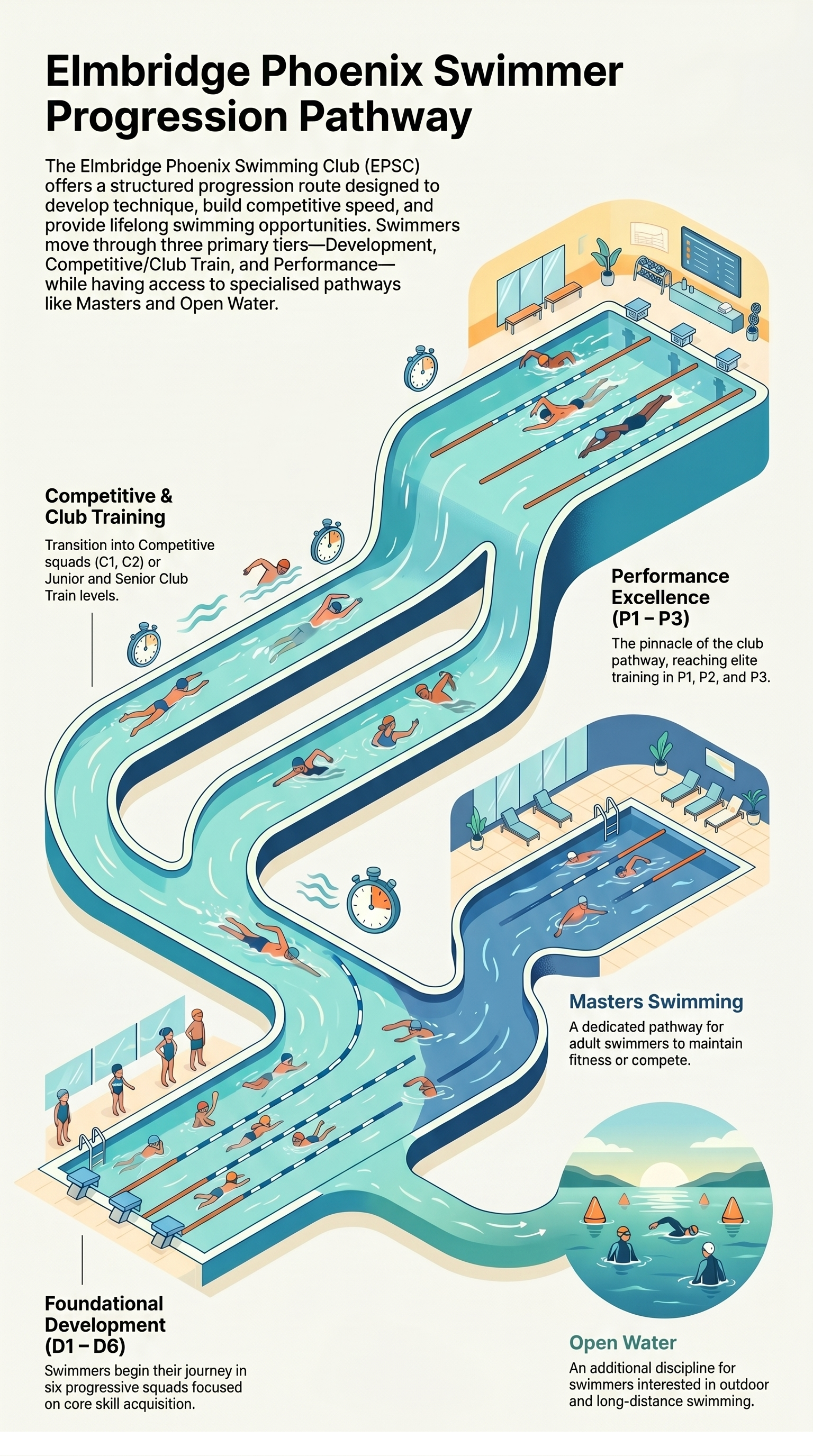

Long-Term Athlete Development (LTAD) Pathway
A Guide for Parents
At our club, we follow the Long-Term Athlete Development (LTAD) principles outlined by British Swimming. This framework is designed to support swimmers at every stage of their journey — from learning fundamental skills to achieving national and international success — while ensuring healthy physical, mental and emotional development.
The pathway recognises that children develop at different rates and that long-term progress is more important than early success.
Below is a summary of each stage, including typical age ranges and key objectives.
Stage 1: FUNdamentals
Typical Age:
- Girls: 5–8
- Boys: 6–9
Focus:
- Learning fundamental movement skills
- Water confidence and enjoyment
- Basic stroke skills across all four strokes
At this stage, the emphasis is on FUN. Swimmers develop agility, balance, coordination and speed through games and varied activities. Technical foundations begin here, but enjoyment and engagement are the priorities.
Early competition is low-pressure and skill-focused.
Stage 2: SwimSkills
Typical Age:
- Girls: 8–11
- Boys: 9–12
Focus:
- Developing correct technique in all four strokes
- Introduction to structured training
- Building aerobic base through skill work
This is one of the most important stages in a swimmer’s development. Technical habits formed here can last a lifetime.
Training remains varied and skill-based. Competition is introduced progressively, but results are not the main focus — skill execution and learning race skills are.
Stage 3: Training to Train
Typical Age:
- Girls: 11–14
- Boys: 12–15
Focus:
- Building aerobic endurance
- Strengthening technical consistency
- Developing work ethic and training habits
This stage often coincides with puberty. Physical and emotional changes can affect performance and coordination.
The priority here is developing a strong aerobic engine and refining stroke efficiency under fatigue. Training volume increases gradually and appropriately.
Competition becomes more structured, but long-term progression remains the goal rather than short-term winning.
Stage 4: Training to Compete
Typical Age:
- Girls: 13–16
- Boys: 14–17
Focus:
- Event specialisation begins
- Increased training intensity
- Race strategy and psychological preparation
Swimmers begin to identify stronger events while maintaining a balanced programme.
Training becomes more demanding and specific. Athletes learn pacing strategies, race planning and mental preparation.
Strength and conditioning may be introduced in a structured way.
Stage 5: Training to Win
Typical Age:
- Girls: 16+
- Boys: 17+
Focus:
- High performance optimisation
- National and international standards
- Marginal gains in performance
This stage is for swimmers targeting elite-level competition.
Training is highly individualised. Recovery, nutrition, psychology and performance analysis become increasingly important.
Stage 6: Active for Life
Not every swimmer will pursue elite performance — and that is absolutely fine.
The LTAD model recognises that lifelong participation in sport is a success. Swimmers may continue competitively, move into masters swimming, coaching, volunteering or simply swim for fitness and enjoyment.
Elbridge Phoenix Club Squad Structure